
Brussels, 18 November 2025
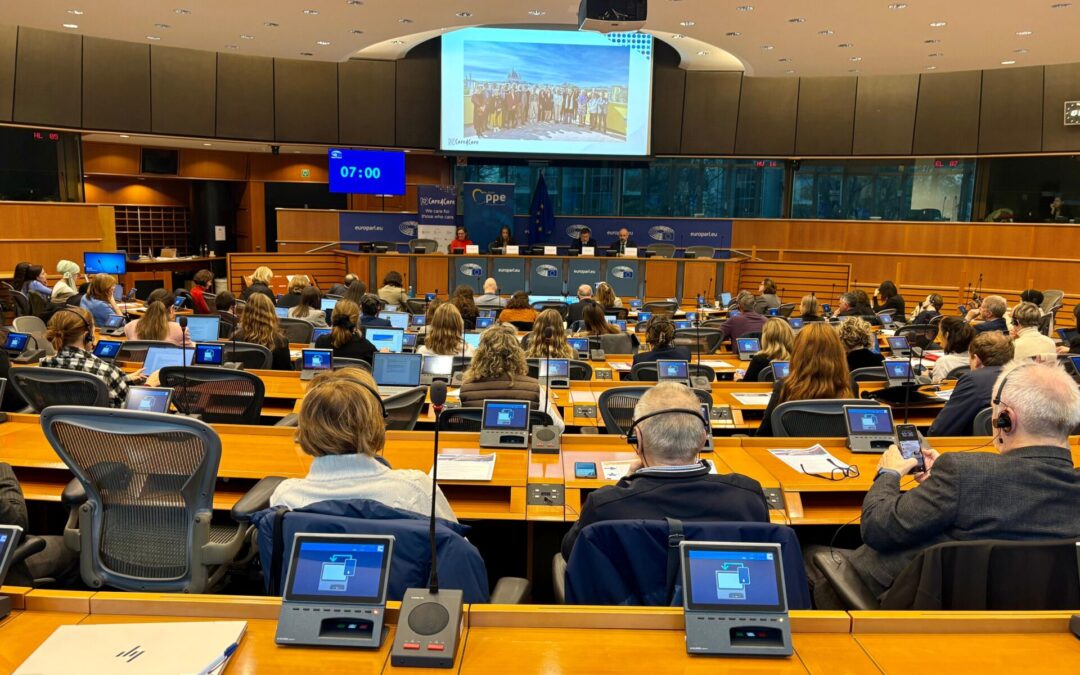
On 18 November 2025, the European Parliament hosted the Final Conference of CARE4CARE, the Horizon Europe project dedicated to improving working conditions in Europe’s care sector. The event, Who Cares for the Carers? Rethinking Work in Europe’s Care Sector, gathered policymakers, European Commission officials, researchers and social partners to discuss the project’s three-year findings and its policy proposals for a sustainable, high-quality care ecosystem across the EU.
Opening the conference, MEP Rosa Estaràs Ferragut, host of the event and co-rapporteur of the report Advancing towards a care society, warned that Europe’s care systems are under strain due to years of undervaluation of care work and rising demographic pressures. She praised the CARE4CARE Policy Paper for providing “the empirical backbone” to strengthen the Parliament’s legislative proposals. Key findings—such as the estimated 6.8 million undeclared workers in Personal and Household Services, most of them migrant women—reinforce the urgency to tackle undeclared work, introduce a European Carers’ Statute, and recognise the skills gained during unpaid caregiving periods.
From the European Commission, Dana-Carmen Bachmann (DG EMPL) placed the discussion within the broader framework of the European Care Strategy, stressing the need for a coherent EU-level approach to long-term care workforce shortages.
Presenting the project’s core research, Prof. Maria Luisa Vallauri (University of Florence) highlighted systemic precarity in the sector: the long-term care workforce is 87% female, and average hourly wages stand at 89% of the overall economy’s average. To respond, CARE4CARE developed an Empowerment Training Model, introduced by Hubert Kotarski (University of Rzeszow), aimed at boosting collective bargaining capacity and emotional resilience among women and migrant workers. Prof. William Chiaromonte (University of Florence) unveiled the CARE4CARE Multilingual Web Platform, designed to strengthen workers’ rights awareness through accessible information on legislation and collective agreements. It can be reached through the link app.care4care.net.
The policy debate underscored several structural challenges. Marianna Baggio (Eurofound) detailed the scale of undeclared work—around 2.1 million workers in long-term care across the EU—defining it as lawful work not declared to authorities. Leonor Tavares (EFSI) stressed that high formal care costs often push families into the undeclared economy, arguing that targeted tax and social incentives are among the most effective tools for formalisation.
MEP Benedetta Scuderi, shadow rapporteur for the Parliament’s care report, connected the care crisis to gender equality, social justice and migration, noting that migrant workers face disproportionate vulnerability. Her contribution highlighted the essential role of political action—and of projects like CARE4CARE—in filling legislative gaps with robust data.
On the social impact of precarious work, Prof. Francisco Medina (University of Seville) described how migrant care workers often face “systematic labour exclusion”, including informal or part-time contracts that heighten stress, isolation, and psychological strain—especially for live-in carers. Aude Boisseuil (EFFE) called for sector-specific solutions to advance recognition of Personal and Household Services, noting the crucial but often overlooked role of families acting as direct employers.
Closing the conference, Elena Ioannou (Permanent Representation of Cyprus to the EU) announced that protecting care workers’ rights will be a priority for the upcoming Cypriot Presidency of the Council of the EU, reaffirming a commitment to ambitious and inclusive care policies.
The CARE4CARE Final Conference marked the culmination of three years of European research but also set the stage for future initiatives to strengthen rights, recognition and protections for those who care for Europe’s most vulnerable.