
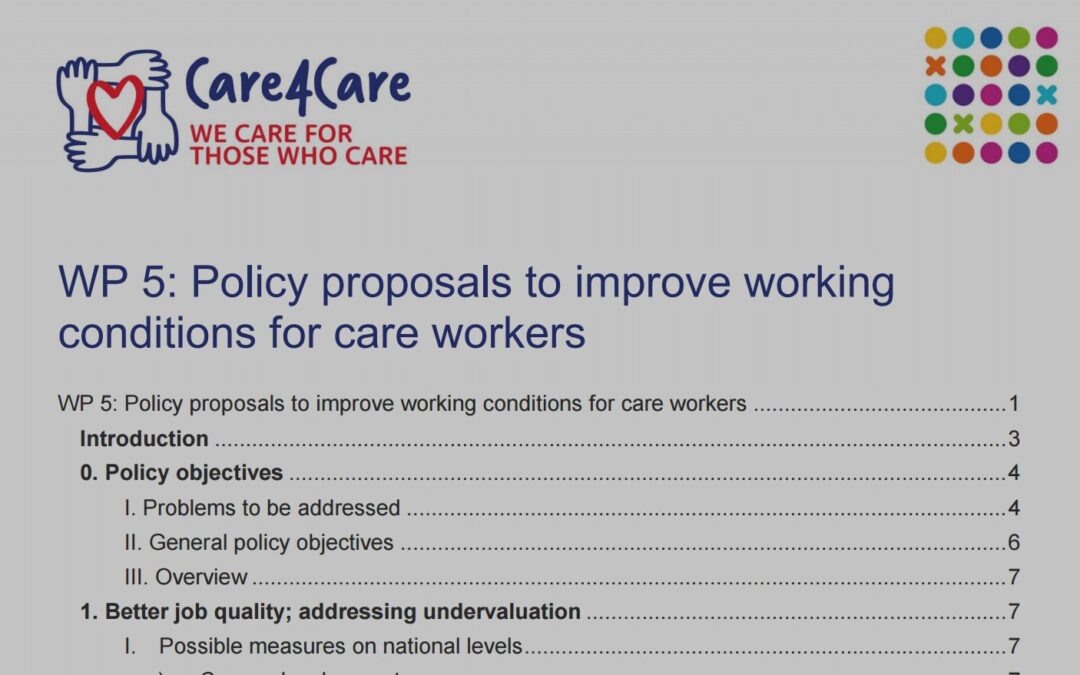
Brussels, 22nd April 2025 – The consortium of the EU-funded research CARE4CARE – “We Care for Those Who Care” is proud to announce the final publication of its flagship Policy Paper, presenting a concrete legislative blueprint to improve the working lives of Europe’s 10 million paid long-term care workers — most of them women and many of them migrants.
Building on two years of comparative legal, socio-economic and psychosocial research in France, Germany, Italy, Poland, Spain and Sweden, the document pinpoints six areas where coordinated action by national governments, EU institutions and social-partners is both urgent and achievable:
- Job quality & undervaluation – career pathways, skills recognition and wage scales that reward complex emotional and intercultural competences.
- Health & safety – enforceable workload ratios, respect for working-time limits and EU-wide prevention of psychosocial risks and third-party violence.
- Live-in & domestic care – universal ratification of ILO Convention 189 of 2011, presumption of employment and professionalised placement agencies.
- Labour migration – safe legal pathways, portable social-security rights and residence permits not tied to a single employer.
- Gender equality – closing persistent pay and pension gaps and embedding gender-mainstreaming in every reform.
- Funding & governance – public subsidies conditional on decent-work standards and an EU quality-assurance framework for person-centred case-management.
“Care workers kept Europe going during the pandemic, yet their jobs remain among the lowest-paid and least protected,” said Professor Maria Luisa Vallauri (University of Florence), scientific coordinator and Principal Investigator of CARE4CARE. “Our Policy Paper shows how targeted regulation and social dialogue can turn this essential sector into one that offers dignified, skilled employment.”
Professor Eva Kocher (Europa-Universität Viadrina), lead author of the paper, added: “From flexible single-permit rules to collective-bargaining incentives, the solutions we propose are realistic, evidence-based and ready to feed into the EU’s Long-Term Care agenda and upcoming national reforms.”
The Policy Paper was refined at a high-level seminar in Brussels with officials from the European Commission’s DG EMPL, trade-union and employer federations, regional authorities and civil-society organisations. Its recommendations now move into the advocacy phase, where consortium partners will brief MEPs, national ministries and social-partner bodies ahead of the new EU legislative term.
To read the full Policy Paper, please consult the download page on the CARE4CARE website.